RSS FEED
Emanuel's news is now available as an RSS feed. (What is RSS?)
NEWS
Ax, Ma & Perlman Perform as a Piano Trio for the First Time
Emanuel Ax to Recieve The 2009 Institute for the Arts and Humanities Medal
From The Columbus Dispatch: "Big-league pianist steps up to plate to help orchestra
"Ax What You Can Do For Your Country" - Alex Ross on his blog The Rest is Noise
"Conductor, pianist inspire grandness" - Concert Review in The Columbus Dispatch
New Blog Post - "A Few More Thoughts on Applause"
From The Boston Globe: "Manny Ax is My New Hero"
Read The New York Times Review of Emanuel Ax's Concert at Avery Fisher Hall
Join Emanuel Ax's Blog Network
See Emanuel Ax Live in 2008/2009
LA Times Review
Seattle Post Intelligencer Review
Star-Ledger Feature
Schenectady's Daily Gazette Feature
Emanuel Ax's New Official Blog
| Ax, Ma & Perlman Perform as a Piano Trio for the First Time | |
For more information and to inquire about tickets to the Penn State concert, click here and here for Carnegie Hall.
|
|
| Emanuel Ax to Recieve The 2009 Institute for the Arts and Humanities Medal | |
|
|
| From The Columbus Dispatch: "Big-league pianist steps up to plate to help orchestra | |
The Columbus DispatchBy Gary BudzakManny Ramirez, a baseball outfielder, will make $25 million this season -- or more than $150,000 a game. Emanuel Ax, as much a superstar in classical music and also a Manny, volunteered to perform twice this weekend with the Columbus Symphony and not be paid a dime. The pianist "agreed to waive his fee for this concert weekend in light of all our recent difficulties," said Tony Beadle, executive director of the orchestra. "We didn't ask him." The fee would have been "substantial," Beadle said. Columbus remains a favorite touring stop for the world-class musician. "I first came to Columbus, I think it was about 30 years ago," Ax, 59, said recently from his New York home. "I've known people for that long, and now I'm beginning to meet the children of those people. "The reason that I'm happy about going down to Columbus, about coming to play, is that it's always been a wonderful orchestra. "It's always been full of really nice people, and I think it's just an incredible tragedy if this orchestra were not to exist. . . . It would be just horrible." Such praise is returned. "He's one of the best-known and one of the most wonderful artists in our midst at this time," Beadle said. "He's in great demand around the country. "I think he's technically perfect, and, musically, he's a great artist. He takes every piece, makes it his own and gives us new insight into the music he plays." Ax, who was born in Poland, started playing at age 6. He lived in Canada before moving to New York, where he became a U.S. citizen in 1970. Married to a pianist, he has two children. Ax has won seven Grammy Awards and an honorary doctorate in music, both from Yale University. He isn't concerned about prizes, though. "I think, for someone like me, it's more of a process rather than any individual things," he said. "I hope I'm improving, and that's the big thing for musicians, you know -- just to keep working and try your best to get better until you're too old to do it." Ax, known for his duets with cellist Yo-Yo Ma and quartets with Ma and violinists Isaac Stern and Jaime Laredo, typically champions new works. "It's very exciting for me to learn a new language sometimes and certainly to do things that haven't been heard before. That's very challenging because, unlike hearing other pieces on record and then learning them, this is really from scratch." For the weekend shows, however, Ax will play a piece more than a century old, from 1881: Piano Concerto No. 2 by Johannes Brahms, with guest conductor Jahja Ling leading the Columbus Symphony. "I think it's one of the most beloved piano concertos in the repertoire, and it's a tour de force for the pianist," Beadle said. "Like a lot of Brahms' music, it encompasses a wide emotional and musical range -- hence its popularity." Ax chose the work. "I know I've been playing it for a long, long time," he said. "It's one of my favorite pieces ever." Audiences, he said, "should let the music wash over them and just be completely taken on a huge ride of beauty and excitement." "I don't know if they have to listen for specific themes or anything like that, but I think it's a very majestic, very touching and very big piece. So I think all of those things will help us take our minds off . . . (the economy)." And, as he notes in his online blog, Ax doesn't mind if the audience applauds between the four movements. "Just one favor," he writes: "Even if you don't like a concert of mine, please, please applaud at the end anyway." Like an athlete, Ax has to prepare for his performances, he said. "I plan my day around the concert: I'll practice in the morning (as he does daily). I'll have lunch. I'll try and take a nap, get a little rest, come back around 6 (p.m.) and warm up and be ready to play for the evening." Despite the tough economic times, he remains optimistic about classical music. "I always like to see the glass as half-full. I think people actually really enjoy what we do, and I think there's actually a lot of interest in it."There are ups and downs, but . . . we're lucky enough to play composers like Brahms who have lasted for so many years. . . . There are always people and performers who want to do that music and hear that music, and I think that's the best sort of proof, I hope, that things will keep going."
|
|
| "Ax What You Can Do For Your Country" - Alex Ross on The Rest is Noise.com | |
Ax what you can do for your countryDrew McManus notes that Emanuel Ax generously waived his fee for his appearance this weekend at the financially troubled Columbus Symphony. "We didn't ask him," Columbus's executive director told the Columbus Dispatch. In the article, Ax continues his skeptical inquiry into the alleged "rule" forbidding applause between movements of a concerto or symphony. On his blog, he wonders why concert audiences behave this way when opera audiences applaud after arias. It's a good question, with no logical answer. The argument that opera is less "serious" than symphonic music won't hold up. Is Tchaikovsky's Eugene Onegin less serious than his First Piano Concerto? Is Don Giovanni less serious than, well, anything? For more, see my endless 2005 post on the history of concert-hall applause. Other pianoblogs: Hough, Biss, and, of course, Denk.
|
|
| Concert Review in The Columbus Dispatch - Conductor, pianist inspire grandness | |
| By Barbara Zuck
The Columbus Symphony continues to play in the major leagues this weekend with two guest artists who rightly earned international acclaim long ago. Guest conductor Jahja Ling's professional career got its start in Ohio with an acclaimed debut leading the Cleveland Orchestra, with which he subsequently had a long and fruitful relationship. And in the highly competitive realm of keyboard artists, there simply is no more important name than that of Emanuel Ax. Though Ax has performed in Columbus many times, one never tires of experiencing his genuine manner and sincere artistry. His performance was given added meaning last night because he has donated that appearance and tonight's to the orchestra, a magnanimous gesture. Ling's leadership of Dvorak's Symphony No. 8 certainly brought out the finest from the players. Notable moments in the first movement, for example, included the gleeful high gestures from the flute and piccolo and impressive statements from the trombones and timpani. Perhaps the one point with which to quibble in what was overall an outstanding reading was the overly deliberate tempo of the last movement, which dampened the music's natural sense of exuberance. Brahms' concerto writing is always highly symphonic and never more so than in the Piano Concerto No. 2 -- with four movements, a truly big piece in every way. With Ax at the keyboard and Ling at the helm, last night's performance was a grand meeting of like minds, beginning with ideal, unhurried tempo choices for each movement. It was not a case of bringing the composer down to size, which would be the wrong goal in any case, but of stepping up to meet the mighty Brahms at his own grand level. Ling's leadership produced rich playing from the orchestra beginning with a well-articulated opening solo from the horn. Ax found the perfect texture and intensity in playing that, while certainly conveying a sense of grandeur, consistently enunciated the pianist's particular point of view -- masterful, powerful, yet never strident. Of the many special ways in which the pianist approached this great music, none was more appreciated last night than his beautiful, lyrical playing of the slow themes. They are among the composer's finest achievements and were given their special due by Ax's honest, sincere playing.
|
|
| New Blog Post: A Few More Thoughts on Applause: Why Can We Interrupt at the Met? | |
|
Read Emanuel Ax's new blog post, "A Few More Thoughts on Applause" by visiting www.emanuelax.wordpress.com.
|
|
| From The Boston Globe: "I'm leading a one-man crusade as a listener to start applauding," | |
|
From The Boston Globe, Make a joyful noise Classical audiences should loosen up and applaud at will By Sam Allis Manny Ax is my new hero. The eminent pianist has challenged a sacred rule that an audience must follow, on pain of death, while listening to an orchestra play classical music. The one that says never applaud between movements. Never, ever, ever. As in, don't even think about it. Most neophytes instinctively clap at the end of a movement they like before they learn better. And why not? The music was glorious and they want to reward the orchestra and/or performer. It is a visceral, immediate response that Ax finds as natural as it is commendable. But then the clappers never clap that way again. Why? Because they're treated like Ebola carriers when they do. No one else in the hall applauds. It's like clapping in the middle of an ocean. You are a tiny, low-rent atoll in a sea of alleged sophisticates. You cringe and think of the ad for Southwest Airlines that asks someone who has just made an egregious no-no, "Wanna get away?" Humiliation, quite simply, is the rite of passage to gain admission into the Grand Order of Aesthetes. (My favorite story comes from a friend in D.C. who in his youth had been a page-turner for a concert pianist. He started clapping at the end of a movement. No one else did. Said pianist stared at him. The audience stared at him. He had nowhere to hide. He was on stage, frozen in the spotlight like a butterfly on a pin. Imagine.) Emanuel Ax wants none of this. "I'm leading a one-man crusade as a listener to start applauding," he says. Ax simply finds the silence diktat silly. "We should welcome applause whenever it comes," he writes in his blog. "And yet, we seem to have set up some very arcane rules as to when it is actually OK to applaud. "I am always taken aback when I hear the first movement of a concerto which is supposed to be full of excitement, passion and virtuoso display [like the Brahms or Beethoven concertos], and then hear a rustling of clothing, punctuated by a few coughs; the sheer force of the music calls for a wild audience reaction. . . . If we feel like expressing approval, we should be allowed to, ANYTIME!" Atta boy, Manny. He adds, "Mozart often wrote to his family that certain variations or sections of pieces were so successful that they had to be encored immediately, even without waiting for the entire piece to end." Mark Volpe, general manager of the Boston Symphony Orchestra, agrees there is a snobbism attached to the vow of silence, and stands firmly with Ax on the applause issue. Volpe also recognizes that an orchestra's goal, particularly in these brutal economic times, must be to expand the classical audience, not terrify newcomers out of the hall. So how did this rule come into being? And who is the culprit behind it? "I've talked to many distinguished musicologists and none of them can figure out who's responsible," says Ax, who has studied the subject extensively. But he has a suspect - Richard Wagner, the brilliant, screamingly anti-Semitic, 19th-century German composer and conductor. The imperious Wagner came up with yet another one of those unpronounceable, unspellable German humdingers - "gesamptkunstwerk" - which means something along the lines of "the total work of art." According to gesamptkunstwerk, audiences can only appreciate the totality of his work by remaining as mute as dormice until the whole shebang is over. "This is an old, old argument," says the conductor André Previn about the applause wars. "There's nothing wrong with it unless it becomes habitual. It's like standing ovations. You get them if the music is not absolutely lousy." "It could bother me if it impinges on the mood of a piece," Previn adds. "If you clapped after the long Bruckner adagio, you'd be in big trouble. But would clapping between movements in general bother me as a conductor? No." Previn points out that in opera, applause after a strong aria is standard. And in jazz, as my friend Charlie notes, listeners routinely applaud during the music after a player ends a great riff. "This is about the trappings of music, not the music," says Ax of the Edict of Silence. "I think that if there were no 'rules' about when to applaud, we in the audience would have the right response almost always." He says people are beginning to applaud more between movements. He attends many concerts and, as a listener, applauds at will with his head held high. So listen up: the ball is in our court. Listeners must summon the gumption to applaud without wilting. But they also need cover from the stage to do so. There is a symbiotic relationship between performer and listener, says Ax, and each side needs to help the other. Ax is always supportive when clappers make noise: "I immediately turn to the audience and bow. We need to show we are responding to what the audiences are doing. I'm hoping it happens more and more." My man. For the record, Manny Ax is not pushing a carnival agenda. Veteran listeners at BSO concerts will always enjoy their silence between movements as a matter of custom and as a moment to digest what they've just heard. But they need to accommodate those who applaud from their hearts after a movement. As Republicans like to claim, it's a big tent. And it is time to loosen the strictures on how we listen to live classical music. Ax's crusade is a splendid one. On with the revolution: Liberté, egalité, fraternité.
|
|
| Emanuel Ax mentioned in the Howard Kissel, of The New York Daily News' Blog - The Cultural Tourist | |
|
Alan Gilbert, the new music director of The New York Philharmonic, held a press conference to discuss the future of the orchestra and its programming. Howard Kissel, from The New York Daily News reports in his blog: "An example of the kind of programming Gilbert envisions is a concert that will feature Charles Ives' "Unanswered Question" and the Beethoven Fourth Piano Concerto. Emanuel Ax, Gilbert said, has agreed to perform the Beethoven right after the Ives. He accepted Gilbert's assessment that "the Ives ends nowhere and the Beethoven begins nowhere," and that perhaps the two pieces will shed light on each other". To read the full entry, please visit www.nydailynews.com
|
|
| Read The New York Times Review of Emanuel Ax's Concert with the New York Philharmonic | |
|
By Allan Kozinn The Strauss, though heard more often, is a slighter work. But it offers pianistic thrills as well as a few moments of dreamy introspection, and Mr. Ax played it with the vitality and thoughtfulness listeners expect of him".
|
|
| Join Emanuel Ax's Blog Network | |
|
Emanuel Ax's critically acclaimed blog has a new home at Wordpress.com. Become a fan at Networked Blogs |
|
|
See Emanuel Ax Live in 2008/2009 Emanuel Ax's 2008 & 2009 North American tour schedule is available by visiting the Tour page of emanuelax.com.
Read the Los Angeles Times Rave Review from the Emanuel Ax & Yefim Bronfman Concert at Walt Disney Hall From the Los Angeles Times More Cheers for Emanuel Ax & Yefim Bronfman on Tour From the Seattle Post Intelligencer By R.M. Campbell Fortunately, Seattle has been able to keep tabs on pianists Emanuel Ax and Yefim Bronfman from their youth in the 1970s to their current status in high middle age. That has not been a boring journey, as their joint recital Tuesday night at Benaroya Hall gave ample testimony. The two pianists, who came to America as immigrants - Ax was born in Poland and Bronfman in Russia - have had distinguished careers that span the globe. It would be hard to find many noted conductors or orchestras with whom they have not performed or concerts halls in which they have not played. They kept their musicianship fresh by alternating solo careers with chamber music and unexpected collaborations, old music with new music. Among those remarkable collaborations are their occasional duo-piano concert tours. Tuesday's concert was their third joint appearance in Seattle, part of a 13-city American tour that dominates their November calendar. The hall was filled with their brilliant pianism, ardent musicality and undiminished virtuosity. Textures were unusually rich and vibrant and details clear. One of the most striking attributes of their playing together is a powerful sense of ensemble. It would seem the two men breathe together, so close are they in tune with each other, not only in terms of stye and sound, but also rhythmic impulse. Their dynamic range was huge, their phrasing suave, their shifts of tempo subtle and bold. The evening opened with brahms' Variations on a THeme by Haydn and concluded with Rachmaninoff's Symphonic Dances. Sandwiched in between were William Bolcom's engaging "Recuerdos" ("Reminiscences") and Mozart's Sonata in D for Two Pianos K. 448. The program had expressive range by virtue of its charm, majesty and wide-ranging bravura. Ax and Bronfman did not short-change the composers or the audience. Brahms' set of variations is better known in its symphonic form, but its version for two pianos has an air of intimacy that is welcome. Ax and Bronfman, who alternated first and second piano, had a sure sense for the Brahms' tuneful variations, each given their own individuality without sacrificing the coherence of the whole. "Recuerdos" was composed by Bolcom in 1991. The local boy (born in Seattle, educated at the University of Washington) who made good has long been intrigued by various combinations of high and low ar. In this homage to Latin America, Bolcom evokes 19th-century dances. The result is immediate, fun and tuneful. Ax and Bronfman sensed its easygoing allure and played with it. The Mozart sonata that followed is a different kettle of fish, yet alo appealing, gallant and fresh, as well as refined. There is little to disturb a gleeful mood. But the work is more than mere "entertainment", to borrow a word from one of Mozart's most distinguished biographers, it also is sublime. Ax and Bronfman captured this duality with verve and attitude. They made Mozart big and important, but with a wink too. Rachmaninoff often appears on their duo programs and so on this occasion it was the two-piano arrangement of Symphonic Dances. The performance was an exhillirating conclusion to an exhillirating concert. The audience was enthusiastic and rewarded with a single encore - a Slavonic dance of Dvorak in which the two pianists moved from two pianos to one. From The Star-Ledger: Good Neighbors Ax and Bronfman Tour as a Piano Duo Some neighbors get together to watch a football game, others organize play dates for their kids. FOr a certain pair of musicians in a certain Upper West Side apartment house, however, sharing the same elevator has led to hitting the road for a series of gigs. In this case, the musicians being Emanuel Ax and Yefim Bronfman, the road trip is taking them to places like Carnegie Hall and the McCarter Theatre Center in Princeton, where the piano virtuosos are playing a duo-recital next week. The Princeton perforance on Wednesday and the New York Recital two days later will be their 10th and 11th stops on a whirlwind national tour that incldues 13 concerts over 19 days. It may sound exhausting, but Ax says traveling with his buddy, whose nickname is "FIma" is invigorating. "We're having a great time," Ax says in an interview from Seattle, where he was preparing for concert number five. "Sure, it may be a little unusual, but we're old friends and neighbors, and the best way to keep our friendship alive is by making music together". It also gives the pair a chance to do the Rachmaninoff "Symphonic Dances for Two Pianos" agian in front of a live audience. "We recorded it six years ago, and we haven't played it since - until now". They will also be doing Brahms' "Variations on a Theme by Haydn for Two Pianos, "the Mozart "Sonata for Two Pianos" and "Recuerdos", as series of Latin American dances by the composer William Bolcom. Ax was born in Poland 49 years ago, grew up in Canada and attended the Juilliard School, whee he now teaches. He is married to pianist Yoko Nozaki, and they have two children. Bronfman, a native of Uzbekistan, is a year older and studied with Leon Fleisher. Both men soared to international fame when they were 17 years old with Ax winning the Arthur Rubinstein International Piano Competition in 1974 and Bronfman debuting with Zubin Mehta and the Montreal Symphony a year later. Their friendship blossomed years later, in 1995, when they found themselves living in the same apartment building. Bronfman was there first, and eventually his new neighbors Manny and Yoko, started popping up for a visit. It didn't take long for them to seque over to the grand piano. And they haven't stopped since. The current tour, which concludes Nov. 23, is the fourth time in 10 years that Ax and Bronfman are traveling together. "We'll continue as long as Fima an dI keep liking each other," says Ax, "which will be a long time, I hope". From Schenectady's Daily Gazette: Emanuel Ax and Yefim Bronfman Make Powerful Piano Twosome Read Yefim Bronfman's interview on his current tour with Emanuel Ax Emanuel Ax's New Blog is Now Live on Wordpress.com Emanuel Ax's critically acclaimed blog has a new home at Wordpress.com. Visit it at www.emanuelax.wordpress.com. Become a fan of the blog on Facebook's Blog Networks by clicking here |
|
I |
|
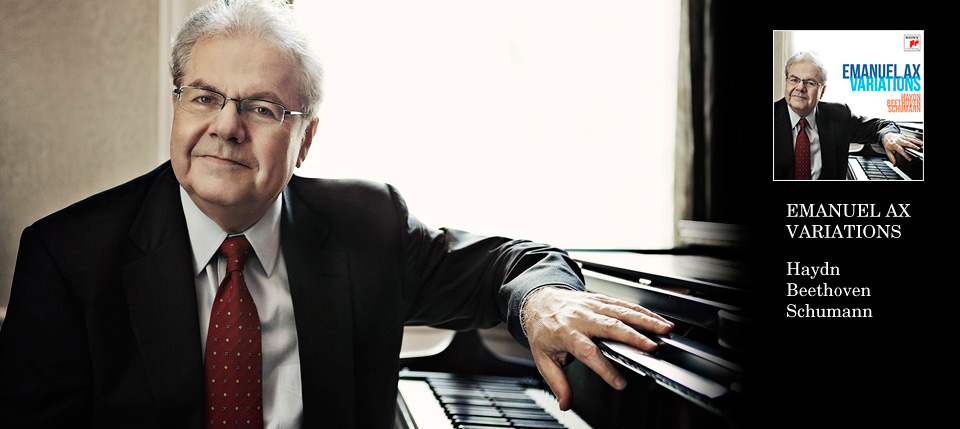
EMANUEL AX, pianist
Born in Lvov, Poland, Emanuel Ax moved to Winnipeg, Canada, with his family when he was a young boy. His studies at the Juilliard School were supported by the sponsorship of the Epstein Scholarship Program of the Boys Clubs of America, and he subsequently won the Young Concert Artists Award. Additionally, he attended Columbia University, where he majored in French. Mr. Ax captured public attention in 1974 when he won the first Arthur Rubinstein International Piano Competition in Tel Aviv. In 1975 he won the Michaels Award of Young Concert Artists followed four years later by the coveted Avery Fisher Prize.
In the 2008-09 season, Mr. Ax returns to several orchestras with which he has had relationships for many years including the Cleveland Orchestra, New York Philharmonic, Los Angeles Philharmonic, San Francisco Symphony, St. Louis Symphony, Toronto Symphony, and Kansas City Symphony where he will perform the world premiere of Stephen Hartke's Piano Concerto. Special projects include a duo recital tour with Yefim Bronfman including performances at Chicago's Orchestra Hall, Walt Disney Concert Hall, and Carnegie Hall; a performance with Itzhak Perlman and Yo-Yo Ma at Carnegie Hall; and a solo recital tour in both North America and Europe. Other European engagements include a tour of the Far East with the Dresden Staatskapelle and Fabio Luisi, with whom he will record the Strauss Burleske for Sony BMG; and performances with the Tonhalle Orchestra, Bayerischer Rundfunk Orchestra in Munich and Carnegie Hall, the London Philharmonia, and Orchestre National de France.
Highlights of the 2007-08 season include performances with the Minnesota Orchestra, the New York Philharmonic, and the Chicago, Houston, Toronto, Pittsburgh, Detroit, and National symphonies. In Europe, he appeared with the Bayerischer Rundfunk Orchestra, the London Philharmonia, the London Philharmonic, and the Deutsches Symphonie Orchester Berlin. A solo recital tour in Europe and North America included performances at London's Wigmore Hall, Amsterdam's Concertgebouw, and Carnegie Hall.
For the opening Gala of the New York Philharmonic in September 2006, Mr. Ax appeared with Mr. Bronfman in Mozart's Concerto for Two Pianos conducted by Lorin Maazel with live national TV coverage. As an "On Location" artist with the Los Angeles Philharmonic in the 2006-07 season, he contributed to a series of chamber and orchestral programs centered around Mozart and Strauss works. With his wife, pianist Yoko Nozaki, a project with the Mark Morris Dance Group originally conceived for New York's Mostly Mozart Festival in the summer of 2006 was repeated in Vienna and London. Tours included a series of Mozart Concerti with Orpheus on the west coast, Florida with the Atlanta Symphony conducted by Robert Spano, a ten-city recital tour, duos with bassist Edgar Meyer, and concerts in Japan with his long-standing colleague and partner Yo-Yo Ma.
In the 2005–06 season, Mr. Ax served as Pianist-in-Residence with the Berlin Philharmonic, performing with the orchestra and Sir Simon Rattle in Berlin and New York. Other recent performance highlights have included separate recital tours with two longstanding colleagues, cellist Yo-Yo Ma and pianist Yefim Bronfman; a tour of the United States with the Dresden Staatskapelle and Myung-Whun Chung (with performances in Carnegie Hall and Boston's Symphony Hall); and a season-long "Perspectives" series focused on the music of Debussy.
Mr. Ax has been an exclusive Sony Classical recording artist since 1987. Recent releases include Strauss's Enoch Arden narrated by Patrick Stewart; discs of two-piano music by Brahms and Rachmaninoff with Yefim Bronfman; and period-instrument performances of Chopin's complete works for piano and orchestra. Mr. Ax has received Grammy awards for the second and third volumes of his cycle of Haydn's piano sonatas. He has also made a series of Grammy-winning recordings with cellist Yo-Yo Ma of the Beethoven and Brahms sonatas for cello and piano. His other recordings include the concertos of Liszt and Schoenberg, three solo Brahms albums, an album of tangos by Astor Piazzolla, and the premiere recording of John Adams's Century Rolls with the Cleveland Orchestra for Nonesuch. In the 2004-05 season Mr. Ax also contributed to a BBC documentary commemorating the Holocaust that aired on the 60th anniversary of the liberation of Auschwitz, and which was awarded a 2005 International Emmy.
In recent years, Mr. Ax has turned his attention toward the music of 20th-century composers, premiering works by John Adams, Christopher Rouse, Krzysztof Penderecki, Bright Sheng, and Melinda Wagner. Mr. Ax is also devoted to chamber music, and he has worked regularly with such artists as Young Uck Kim, Cho-Liang Lin, Mr. Ma, Edgar Meyer, Peter Serkin, Jaime Laredo, and the late Isaac Stern.
Mr. Ax resides in New York City with his wife, pianist Yoko Nozaki. They have two children together, Joseph and Sarah. He is a Fellow of the American Academy of Arts and Sciences and holds honorary doctorates of music from Yale and Columbia Universities.
Ludwig van Beethoven (1770 - 1827)
Johannes Brahms (1833 - 1897)
Frédéric Chopin (1810 - 1849)
Antonín Dvorák (1841 - 1904)
Gabriel Fauré (1845 - 1924)
Joseph Haydn (1732 - 1809)
Peter Lieberson (b. 1946)
Franz Liszt (1811 - 1886)
Astor Piazzolla (1921 - 1992)
Wolfgang Amadeus Mozart (1756 - 1791)
Sergei Prokofiev (1891 - 1953)
Sergei Rachmaninoff (1873 - 1943)
Richard Strauss (1864 - 1949)
Franz Schubert (1797 - 1828)
Dimitri Shostakovich (1906 - 1975)
![]() |
Beethoven Complete Cello Sonatas With Yo-Yo Ma, cello |
| Ludwig van Beethoven (1770 - 1827) Disc 1. Sonata in No. 1 inF Major for Cello and Piano, Op 1 1. I. Adagio sostenuto-Allegro-Adagio-Presto 2. II. Rondo: Allegro vivace Sonata No. 2 in G minor for Cello and Piano 3. I. Adagio sostenuto e espressivo-Allegro molto piu tosto presto 4. II. Rondo: Allegro Sonata No. 4 for Cello and Piano inC Major, Op. 102 5. I. Andante; Allegro vivace 6. II. Adagio; Allegro vivace Disc 2 Sonata No. 3 in A Major for Cello and Piano, Op. 69 1. I. Allegro ma non tanto 2. II. Scherzo: Allegro molto 3. III. Adagio cantabile; Allegro vivace Sonata No. 5 in D Major for Cello and Piano, Op. 102, No. 2 4. I. Allegro con brio 5. II. Adagio con molto sentimento d'affetto 6. Allegro fugato 7. Seven Variation in E-flat Major on the Theme Bei Männern, Welche Liebe Fühlen, from Mozart's Die Zauberflüte, WoO 46 8. Twelve Variations in F Major on the Theme Ein Mädchen Oder Weibchen, from Mozart's Die Zauberflüte, Op. 66 |
|
![]() |
Beethoven: Piano Concerto No. 5 "Emperor"*; Choral Fantasia^ *Royal Philharmonic Orchestra; André Previn, conductor ^New York Philharmonic; New York Choral Artists; Joseph Flummerfelt, chorus director; Zubin Mehta, conductor |
|
|
Ludwig van Beethoven (1770 - 1827) Piano Concerto No. 5, Op. 73 "Emperor" in E-Flat Major |
![]() |
Beethoven: Piano Concertos 1 - 5 The Complete Collection ^New York Philharmonic; New York Choral Artists; Joseph Flummerfelt, chorus director; Zubin Mehta, conductor |
|
|
Ludwig van Beethoven (1770 - 1827) Disc 1 Piano Concerto No. 2, Op. 19 in B Flat Major Disc 2 4. Allegro moderato 5. Andante con moto 6. Rondo: Vivace Disc 3 |
![]() |
Beethoven: Piano Concertos 4 & 5 Royal Philharmonic Orchestra; André Previn, conductor |
Ludwig van Beethoven (1770 - 1827) Piano Concerto No. 3, Op. 37 in C minor* 4. Allegro moderato 5. Andante con moto 6. Rondo: Vivace |
|
![]() |
Beethoven: Cello Sonata No. 4; Variations With Yo-Yo Ma, cello |
| Back to top | Ludwig van Beethoven (1770 - 1827) Sonata No. 4 for Cello and Piano in C Major, Op. 102, No. 1 |
![]() |
Beethoven: Cello Sonatas, Op. 5, Nos. 1 & 2 With Yo-Yo Ma, cello |
|
|
Ludwig van Beethoven (1770 - 1827) Sonata No. 1 in F Major for Cello and Piano, Op. 5 |
![]() |
Beethoven: Cello Sonatas Nos. 3 & 5 With Yo-Yo Ma, cello |
|
|
Ludwig van Beethoven (1770 - 1827) Sonata No. 3 in A Major for Cello and Piano, Op. 69 |
![]() |
Beethoven, Schumann: Piano Quartets With Jaime Laredo, viola; Yo-Yo Ma, cello & Isaac Stern, violin |
|
|
Ludwig van Beethoven (1770 - 1827) Piano Quartet in E-flat Major, Op. 16 |
![]() |
Brahms, Beethoven, Mozart: Clarinet Trios -Expanded Edition With Richard Stoltzman, clarinet; Yo-Yo Ma, cello; Alexander Heller, bassoon |
|
Trio in A minor for Piano, Clarinet and Cello, Op. 114 Ludwig van Beethoven (1770 - 1827) Trio in B-flat Major for Piano, Clarinet and Cello, Op. 11 Wolfgang Amadeus Mozart (1756 - 1791) Trio in E-flat Major for Piano, Clarinet and Viola (Cello), K. 498 Sonata in B-flat Major for Bassoon and Cello, K. 292 |
![]() |
Brahms: Double Concerto With Isaac Stern, violin; Yo-Yo Ma, cello; Jaime Laredo, viola; Chicago Symphony Orchestra; Claudio Abbado, conductor |
|
|
Johannes Brahms (1833 - 1897) Concerto for Violin, Cello and Orchestra in A minor, Op. 102 1. Allegro 2. II. Andante 3. III. Vivace non troppo Piano Quartet No. 3 in C minor, Op. 60 4. I. Allegro non troppo 5. II. Scherzo: Allegro 6. III. Andante 7. IV. Finale: Allegro comodo |
![]() |
Brahms: Sonata for Two Pianos; Variations on a Theme By Haydn With Yefim Bronfman, piano |
|
|
Johannes Brahms (1833 - 1897) Sonata in F minor for Two Pianos, O/ 34b |
![]() |
Brahms: Concerto No. 2 for Piano and Orchestra, Op. 83 & Sonata in D Major, Op. 78 With Yo-Yo Ma^, cello; Boston Symphony Orchestra*; Bernard Haitink, conductor* |
|
|
Johannes Brahms (1833 - 1897) Concerto No. 2 in B-flat Major for Piano and Orchestra, Op. 83^ |
![]() |
Brahms: Piano Concertos, Two Rhapsodies, Op. 79; Intermezzos, Op. 117 & Op. 119 With the Chicago Symphony Orchestra; James Levine, conductor*; Boston Symphony Orchestra; Bernard Haitink, conductor |
Johannes Brahms (1833 - 1897)
Disc 1 |
|
![]() |
Brahms: Sonata for Cello & Piano With Yo-Yo Ma, cello
|
|
|
Johannes Brahms (1833 - 1897) Sonata for Celo and Piano in E minor, op. 38 |
![]() |
Brahms: Piano Quartets With Isaac Stern, violin; Jaime Laredo, viola; Yo-Yo Ma, cello |
|
|
Johannes Brahms (1833 - 1897) Disc 1 |
![]() |
Brahms: Handel Variations, Six Piano Pieces, Op. 118 & Rhapsodies, Op. 79 |
|
|
Johannes Brahms (1833 - 1897) Variations and Fugue on a Theme by Handel, Op. 24 |
![]() |
Brahms, Beethoven, Mozart: Clarinet Trios With Richard Stoltzman, clarinet & Yo-Yo Ma, cello |
|
|
Johannes Brahms (1833 - 1897) Trio in A minor for Piano, Clarinet and Cello, Op. 114 Ludwig van Beethoven (1770 - 1827) Trio in B-flat Major for Piano, Clarinet and Cello, Op. 11 Wolfgang Amadeus Mozart (1756 - 1791) Trio in E-flat Major for Piano, Clarinet and Viola (Cello), K. 498 |
![]() |
Chopin: Ballades & Mazurkas; Scherzos and Other Works |
Frédéric Chopin (1810 - 1849) Disc 1 |
|
![]() |
Chopin: Concerto for Piano and Orchestra, No. 2 in F minor, Op. 21 Orchestra of the Age of Enlightenment, Sir charles Mackerras, conductor |
|
|
Frédéric Chopin (1810 - 1849) Concerto for Piano and Orchestra No. 2 in F minor, Op. 21 1. I. Maestoso2. II. Larghetto 3. III. Allegro vivace 4. Grand Fantasia on Polish Airs for Piano and Orchestra in A Major, Op. 13 Grande Polonaise for Piano and Orchestra (preceded by an Andante Spianato) 5. Andante spinatoin G Major, Tranquillo 6. Grande Polonaise. Molto allegro in E-flat Major) |
![]() |
Chopin: Piano Concerto No. 1; Grande Valse Brillante; Variations on La Ci Darem La Mano Catherine Mackintosh, violinOrchestra of the Age of Enlightemnet; Sir Charles Mackerras, conductor |
|
|
Frédéric Chopin (1810 - 1849) Piano Concerto No. 1 in E minor, Op. 11* |
![]() |
Chopin: Piano Concertos Nos. 1 & 2 With the Philadelphia Orchestra; Eugene Ormandy, conductor |
|
|
Frédéric Chopin (1810 - 1849) Piano Concerto No. 1 in E minor |
![]() |
Chopin: Trio for Violin, Cello and Piano in G minor, Op. 8 With Yo-Yo Ma, cello & Pamela Frank, violin |
|
|
Frédéric Chopin (1810 - 1849) Trio for Violin, Cello and Piano in G minor, Op. 8 1. I. Allegro con fuoco 2. II. Scherzo. Con moto, ma non troppo 3. III. Adagio sostenuto 4. IV. Finale. Allegretto 5. Polonaise Brillante in C Major, Op. 3 Sonata for Cello and Piano, Op. 65 6. I. Allegro moderato 7. II. Scherzo. Allegro con brio 8. III. Largo 9. IV. Finale 10. Polonaise Brillante in C Major, Op. 3 |
![]() |
Chopin: Scherzos & Mazurkas
|
|
|
Frédéric Chopin (1810 - 1849) Scherzo |
![]() |
With Yo-Yo Ma, cello & Young Uck Kim, violin
|
|
|
Antonín Dvorák (1841 - 1904) Trio for Piano, Violin and Cello in F minor, Op. 65 |
![]() |
With Yo-Yo Ma, cello, Isaac Stern, violin & Jaime Laredo, viola |
|
|
Gabriel Fauré (1845 - 1924) Quartet No. 1 in C minor for Piano & Strings, Op. 15 |
![]() |
Fauré: Piano Quartets With Yo-Yo Ma, cello, Isaac Stern, violin & Jaime Laredo, viola *Kathryn Stott, piano |
|
|
Gabriel Fauré (1845 - 1924) Quartet No. 1 in C minor for Piano & Strings, Op. 15 9. Méditation from Thaïs* |
![]() |
Haydn: Concertos for Piano and Orchestra With the Franz Liszt Chamber Orchestra; |
|
|
Concerto in F Major for Piano and Strings, Hob. XVIII: 3 |
![]() |
Haydn: Piano Sonatas |
| Back to top | Joseph Haydn (1732 - 1809) Sonata No. 31 in A-flat Major, Hob. XVI: 46 |
![]() |
Haydn: Piano Sonatas nos. 32, 47, 53 & 59 |
| Back to top | Joseph Haydn (1732 - 1809) Piano Sonata No. 47 in B minor, Hob. XVI: 32 |
![]() |
Haydn: Piano Sonatas Nos. 33, 38, 58 & 60 |
|
|
Joseph Haydn (1732 - 1809) Sonata No. 58 in C Major for Piano, Hob. XVI: 48 |
![]() |
With: András Adjorán, flute; Stefan Hüge, percussion; Yo-Yo Ma, celloDeborah Marshall, clarinet; William Purvis, french Horn; Peter Serkin, piano;David Taylor, trombone; |
|
|
Peter Lieberson (b. 1946) King Gesar (1991 - 92) 1. Part I - Calling on the Power of Goodness in Men's Hearts: An Invocation to the Imperial Drala, Gesar, King of Ling 2. Part II - The Birth of Gesar 3. Part III - Gesar in the Desert 4. Part IV - The Horse Race 5. Part V - The Song of Manene 6. Part VI - The Battle with the Tirthikas 7. Part VII - Gesar's Song of Completion |
Please click on the venue name for more information and to purchase tickets. 2009 Date: March 24 & 25 Date: March 30 Date: March 31 Date: April 3, 4 & 5 Date: April 16 Date: April 19 Date: April 23 Date: May 3 Date: May 4 Date: May 7 Date: May 9 Date: May 13 Date: May 16 Date: May 20 Date: June 17 & 18 Date: July 10 Date: August 5 & 6 Date: August 11 Date: August 13 Date: August 18 - 22 |
Thanks for signing up!


